GOODFINDING ebook Now On Sale for $.99!
Child Anger Management
A Guide For Parents, Teachers and Caregivers
Authored by William G. DeFoore, Ph.D.

The most important thing to know about child anger management, if you don't already know it, is that your child's anger is a healthy, natural emotion. When children have anger problems, there is always a very good reason.
They are not "bad" because of their anger. The key is to find the underlying causes of their anger and resolve those issues.
And that's exactly what you're going to do while you're here!

Many parents want to find out what causes their children anger management problems. If you're willing to make the changes you need to make in your own thoughts and feelings, you can teach your child that they are their own best anger management resource.
Do you have a story or question to share? We'd love to hear from you, and you might get some free counseling as a result.
Three Essential Steps To Helping Your Children
Here are three things you must do in order to help with anger management for children:
1. Have empathy for the child--once you find out why the child is angry, you will have a better understanding of their viewpoint, and you'll be able to have empathy for them. Empathy is absolutely necessary if you're going to provide child anger management for child stress problems!

2. Take responsibility for your own anger in the child anger management process. As a mom, dad, teacher or caregiver, you are very powerful in this child's life, whether you realize it or not! To provide good child anger management, you have to look at what you're bringing to the table. Are you angry? That doesn't mean you're a bad person. You wouldn't be reading this if you didn't want to help, so let's make sure that happens, so that you're not one of those angry parents!
3. Give the child the knowledge and skills they need to understand, manage and express--not only their anger, but all of their emotions! Keep in mind that if you haven't done 1. and 2., you won't succeed with this child anger management strategy!
Learn about handling temper tantrums, how to stop bullying and last but not least, how to understand and prevent school violence.
Does your child have ADD or ADHD? Find out how you can help! Your response as a parent makes all the difference in how this diagnosis affects your son or daughter and which ADD treatment you choose.
Child Anger Management Techniques
What to say
- This is where you acknowledge the child's anger without punishing or rewarding it. Say something like, "Okay, I can see that you're angry. I'm sure you've got good reasons to be mad. I can see that your anger is very strong. It's okay with me for you to be angry, I just want to make sure you don't hurt yourself or anybody else with it." These are things you really want your child to understand for healthy child anger management.
- Use active listening (also called reflective listening). This may be one of the most important parenting skills you will ever need to learn. Here's how it works: Just repeat the same words you just heard your child say, in a calm, relaxed voice. This will comfort your child, and helps her to really feel heard. Use phrases like, "What I hear you saying is..." or "If I understand you right, you said..." or "Let me see if I'm getting this right..." You have to use your child's words, if this is going to work, without interpreting it or putting it into your own words. When kids are upset, the main thing they want is to be heard, even if what they're saying doesn't make a lot of sense.
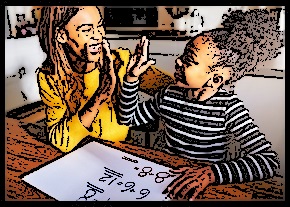
- Show empathy and validation for your child's feelings. This is where you try to see things from your child's viewpoint. To master this child anger management technique, say, "When I look at this from your viewpoint, I can see how you would feel that way," or "From where you stand, it looks like ..." or "I think I see what you mean" or "That makes sense to me."
- Don't teach, correct or instruct . When children are angry, they don't listen. They want you to hear and understand them, but the emotion of anger makes it almost impossible for them to listen and process your input. If you can get them to calm down a little, they may be able to listen to a story from you, about your past and how you have handled the type of problem they're having. Discipline won't help here. This is a time for calming and reassuring your child, with the understanding that fear is right behind their anger. If they have done something wrong, or really destructive, you will want to give them consequences for that behavior, when they're calm enough to listen. Be sure they know the consequences are for the behavior, not for their anger.
What to do
- Get on the same level with your child, so that you are not talking down to them in any way. Good child anger management is always respectful, and helps with the child's self esteem.
- If your child is extremely angry, it will help for you to move shoulder-to-shoulder to them, so that it feels like you're on the same side, wanting the same things. You want to send the nonverbal message that, "We're in this together, and I'm going to help you."
- Physical touch is a very important part of good communication with a child. You have to be the judge here, as sometimes touch helps, and sometimes it can make things worse. Sometimes a hug or a hand on the shoulder can help to calm an angry child, and sometimes you need to let them calm down a little first before using touch as part of your child anger management. One of the best parenting tips I can offer you is to trust yourself. If you're unstable, or too angry yourself, get professional help before trying to discipline your child.

- Try to keep a pleasant, relaxed facial expression. If you can muster up a slight smile that feels real, this can help to reassure your child. Your facial expression is an extremely powerful part of the message you're sending your child. Some great stress management techniques for you personally can be very helpful here as well.
- Talk in a calm, reassuring voice. If you have a hard time doing this, practice your own anger management techniques to calm down before talking to your child.
- For a child that is small enough, you can try holding him gently and firmly from behind during temper tantrums. This works very well in some cases. The child is comforted through safe, strong and loving touch that prevents harm to anyone. If you use this technique, say to the child, "I've got you. You're safe now. I'm going to hold you until you realize you're okay." To make this child anger management technique safe and helpful:
- Do not try this if you're very angry or anxious yourself. You can't help the child relax and feel safe unless you can relax your own body.
- If it feels right to you, take the child and put her in your lap, facing away from you. If she's in the middle of a tantrum, make sure you protect your own face from her head tossing back. It's your job to make sure no one gets hurt.
- Hopefully, you can communicate both love, safety and healthy power in your embrace. Try to strike a balance between firm and relaxed.
- Don't do this if you're in a hurry. It may take the child a while to calm down--they might even go to sleep in your arms. Often he might cry himself to sleep or emotional exhaustion.
- This child anger management technique communicates safety, boundaries, love and strength, at the same time.
What to have your child do
In some cases, the child may need to release anger physically. You can accomplish this in a number of ways:

- Play Therapy with a qualified professional can really help some children with child anger management. The therapeutic play becomes a language that the child can safely use to explain what's going on in their home, and how they really feel.
- Physical release of anger may be appropriate for some children--again, you have to be the judge of what is best for you and your child. Learn more about anger management games.
- It may help your child to learn the temper tantrum technique described in detail in our anger book. If you have any doubts about using these methods, you may want to seek professional advice.
- A very good parent I know explained that he taught his children the "Name it, claim it, aim it" child anger management game for managing their anger. When they name it, claim it and aim it into healthy behavior, they are taking responsibility and good choices.
Learn more about helping young children deal with anger.
You know what? You're a champion! You are a champion because you came here to help a child with anger management. Follow the parenting skills information and guidelines you find here, and you might just keep a child from "going bad."
And you might even save someone else's life--as in the case of child anger management actually moving into the area of school violence.
I encourage you to keep up the good work, and don't let anything stop you in your efforts to help the children with child anger management issues in your life!
More Important Articles On This Topic
Child Behavior Problem--Learn about multiple approaches to understanding and treating child behavior problems. some of which parents can implement on their own.
Defiant Children--understand and deal with this problem in your family, your school or community. Defiant children are not bad, and you can definitely help.
Oppositional Defiant Disorder--this is the diagnosis kids get when they are defiant on a consistent ongoing basis. Find out what you can do to bring out the good child or teenager!
Healing For The Angry Mother--learn how this gets started, and how you can change it. No mother wants to be angry, and it can happen to good folks. But it doesn't have to be that way.
Parenting Tips--Get specific guidance and pointers about how to work with angry and ADHD kids, in your home or your school. You'll learn these aren't bad kids, and you can help to bring out the best in them.
Stress Management Strategies--Sometimes managing stress can be the first step to better child anger management. If you're stressed out as a parent, you'll have a hard time being the good parent you want to be.
Have A Story Or Question About
Child Anger?
Do you have a great story or question about this? Share it! We'd love to hear from you, and your submission will be published as a web page, if selected.
Feel free to also review our FAQ page (frequently asked questions), to see if your question has already been answered.
Please check the blue question mark below for instructions--it's easy!
What Other Visitors Have Said
Click below to see contributions from other visitors to this page...
My Sister Is Having A Really Hard Time 
Hi. I hope you can help me. I am 14 and my little sister is 10. She has had some anger problems for a long time, but in the past year or so they've really …
My Brother Is Destroying My Life.
I'm sure the title seems dramatic, and perhaps it is, but I don't think I'm exaggerating. It has been two years since my 14 years old brother decided …
Disrespectful 19 Year Old Son And My Husband Enables Him
Our only child is 19, soon to be 20. He's very disrespectful to my husband and myself but mostly to me. I recognize that this disrespect is mostly …
Losing Hope With My 10 Year Old Son
My 10 year old Jake is angry all the time. He swears at me, my husband, his siblings. He likes to irritate his siblings, like the other night he kept …
My 4 Year Old Scratches And Hits
I am unsure what to do. My son is 3, and will be 4 in a couple of months. Both my husband and myself work full time, which leaves our son in preschool …
This Mother Needs Help
I don't even know why I am here, writing this for the world to see. But I don't feel like I can tell anyone that I know, so here I am. I am a mother …
Kids And Anger Management
Being a mother of two young boys can cause you to think that you no doubt need a lesson in anger management. I suppose having children of any age can also …
My Four Year Old Son Was Molested Not rated yet
When my son was 4 I was a single parent and my son had visitation with his dad. His dad had started dating a lady with two sons who were 5 and 9 1/2. …
My Daughter Beats On Me Every Day And I've Tried Everything Not rated yet
My daughter was an unhappy infant. The doctor told me to take her to the emergency room after more than one continuous hour of screaming. I had to take …
- Home
- Child Anger
We receive commissions on Amazon sales on this website.


Subscribe To The Newsletter
And Get A Free Ebook!

Recent Articles


-
Am I Somehow Deserving Of The Abuse?
Oct 16, 23 08:44 AM
 Dear Dr. DeFoore, I have been married for over 6 years and my relationship has become unrecognizable and full of resentment and hatred. Over the last
 -
The War In My Mind Or My Reality?
Jul 13, 23 09:08 AM
 I share my short story of endurance with triggers of my past military wounds to help heal myself and others. To inspire you to believe in yourself and
 -
Completely Confused By 20 Year Old Son's Behavior
Jul 06, 22 08:59 AM
 My son is 20 years old. He is extremely intelligent. He excelled in school and was at the top of his high school senior class. He was accepted into every
New! Comments
Have your say about what you just read! Leave me a comment in the box below.