GOODFINDING ebook Now On Sale for $.99!
Anger Management Assessment
Where You Stand & What To Do
Authored by William G. DeFoore, Ph.D.

This anger management assessment will show your patterns of escalation and your overall anger reaction tendencies.
Based on Dr. DeFoore's 40+ years of professional experience in the field of counseling and psychology, the results will help you understand your anger issues at a deeper level while giving you steps to heal and improve yourself and your relationships.
Here's how this anger management assessment works:

- Complete the assessment by clicking the "Take The Test" button below. (It's only $4.95)
- Answer all of the questions.
- Read the results page carefully, and follow all of the links provided as recommendations for anger management help.
- You can also read over the 10 levels of anger escalation below on this page, as well as the results categories.
Anger Management Assessment & Escalation Scale
This online assessment will help you identify escalation patterns, or how fast you move up and down the anger scale. For the test to be helpful to you, you will need to give accurate, honest answers.
 Free Ebook With The Test
It costs only $4.95 to take the anger management assessment online and receive recommendations from Dr. DeFoore and the free Anger Management Techniques Ebook. Or, if you prefer you can read through the content below.

Levels Of Anger Escalation
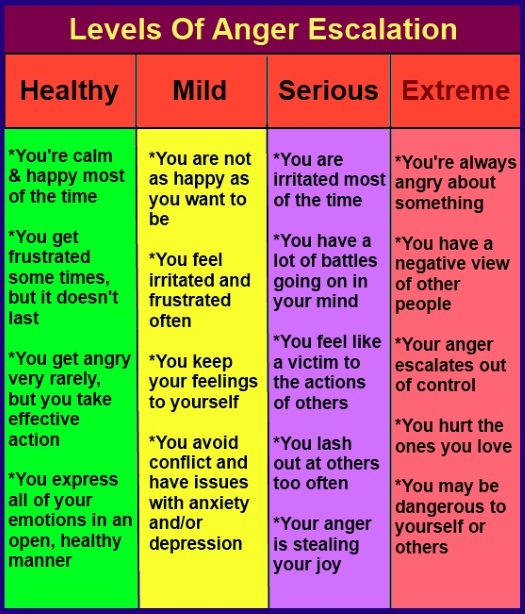
I encourage you to take the anger management assessment above--just click on the "Take The Test" button. Here is a description of the levels:
Level 1. This is where you're cool, calm and collected. You may or may not be real happy, but you're definitely not angry, anxious or irritated. If this was you most of the time, you wouldn't even be reading about this anger management assessment.
Level 2. You're feeling slightly irritated or agitated, but it's not enough to bother you or affect your behavior. You can see the big picture when you think about your problems. It is hard to relax with the agitation you are experiencing, however.
Level 3. The irritation and frustration is pretty high, and it's just starting to affect your behavior. It is almost possible to relax with the agitation you are experiencing. It's getting harder to see the big picture and have empathy with other people.
Level 4. People are really starting to bother you, and you have very little patience, although you usually don't say anything. You are still stuffing your anger, and you don't feel settled at all. You can still focus enough to make good decisions.

Level 5. Now you are ready to yell at that other driver, or call the people you're mad at and give them a piece of your mind. But you don't act on the feelings. You're getting short and irritable with others, but you're still trying to be friendly. You're starting to have tunnel vision.
Level 6. At this level, it's just not fun anymore. You are frustrated and angry with yourself and pretty much everybody else. Others are starting to notice that something is wrong, as you become more short-tempered and irritable. Your thinking may not be as clear as it usually is.
Level 7. You are thinking stuff like, "This has to stop." "I can't take this any more." "I'm going to show them they can't do this to me." "They'll get what's coming to them." You have racing thoughts, and you're very tense. You keep thinking the same things over and over. That's why you decided to take this anger management assessment.
Level 8. Now you're coming up with a plan. You can't take it any more, so you're going to take action. You feel like you have no choice, because something has to change. You're not thinking clearly, and even though you know it might backfire, you're thinking about getting even and retaliating.
Level 9. Now you're taking action. This is where the yelling, threatening and intimidating starts. You're thinking about what you can do to the other person(s) to show them how angry you are, and how wrong they are. Your emotions are ruling you at this level. You really need some anger management help, but you probably don't know it.
Level 10. At this level, you are dangerous to yourself and/or others. You are in a fight-or-flight mode, and your primitive reptilian brain has taken over. You have tunnel vision and single-minded thought. All you can think about is how to make the pain stop. You feel helpless, but you can't stand that feeling. You are desperate. Your anger is doing your thinking for you. It's a really good thing that you took this anger management assessment.
Your Anger Management Assessment Results
Mild Anger Issues: At your best you are at level 1-2, and at your worst you jump up to a level 5-7. Most of the time you are around a 2 or 3. A few times in your life you may have reached levels 8-10, but you're determined never to go there again. Completing this anger management assessment, reading our anger books, and listening to our audio CD programs may be enough to help you reach your goals. Basic stress management techniques can also be very helpful at this point. Be aware of the signs of depression at this level, because depression can sometimes accompany mild anger issues. You will probably know it if you need anger management counseling, and you may also benefit from our Anger Management Programs.
Serious Anger Issues: At your best you are at level 2-4, and at your worst you jump pretty fast to level 8 or 9. Most of the time you are between 3 and 6. You have reached level 10 a few times, but usually you can prevent that. You haven't hurt any one physically, but you are definitely hurting others with your words and actions, as in the form of emotional abuse. You need professional help in addition to reading and listening to CD programs. This anger management assessment is just your first step. Take action now, by going to our products and services links on the left of this page.

Extreme Anger Issues: When you are at your best you are around levels 2-5, and you can go to level 10 in a heart beat. You spend most of your time around levels 4-7. Your anger is in charge, so much that sometimes you don't even know the difference between your anger and yourself. You are probably in some abusive relationships, in which you are the abuser. Your loved ones, friends and maybe even strangers are not safe around you, emotionally or physically. You may be showing the symptoms of Intermittent Explosive Disorder, or anger addiction. Take action now, so that your anger does not continue to run (and possibly ruin) your life! You'll find what you need on the menu bar on the left of this page.
Emotionally Healthy: At your best you are at a level 0. At your worst you go to a level 2-3, but when you do you use your anger to fuel effective action. Most of the time you are level 0-1. You are apparently doing a good job in managing your anger, and hopefully you're experiencing the health and happiness you want as a result. Keep up the good work! You may also want to improve your marriage or learn to forgive if you've been having trouble in your relationships. Whatever is going on in your life, you will benefit from learning the art of gratitude, appreciation and optimism. You are a fortunate person in many ways. Be sure you pay attention to your blessings, and remember them every day. You are worthy of a good life!
Still not sure? Take another anger management assessment designed by A.J. Novick, Ph.D. This is an excellent online assessment, and that's why we are an affiliate of Dr. Novick and his programs, where we earn commissions for purchases made on his site through links from ours.
Want Some Free Online Counseling?
Have A Question Or Story?
Here's your chance to ask Dr. DeFoore about your situation. It can be about your anger, somebody else's anger, or about grief, road rage, anxiety or depression. Tell your story with as much detail as possible, and he will give you some free counseling.
Feel free to also review our FAQ page (frequently asked questions), to see if your question has already been answered.
Then, if selected, the results will be a web page on this site that will help others! So, there you go--help and be helped! By the way, you can be anonymous if you choose, but if you include your first name, it's better.
What Other Visitors Have Said
Click below to see contributions from other visitors to this page...
Just Me 
I really don't know what to say, but I have so much hell in me I just don't know what to do. At first I could control it, but now there is no stopping …
Anger In Progress
I've always vowed to not be like my dad. My family feared his angry, abusive side. When my siblings and I were young, my dad would leave the house any …
My Anger Is Out Of Control And I Don't Know Where It Comes From Not rated yet
I'm normally not an angry person. I think I have great heart and respect other people's views and feelings 99% of the time. It's when something triggers …
Defuse The Lit Fuse Not rated yet
I had a second grade classmate that had acted very foolishly. While everyone was lined up ready to enter into the school, all of the boys were standing …
I Can't Cope Sometimes Not rated yet
First boyfriend I had controlled me to the point of breaking down every other day. I was only fourteen and so was he, but he was incredibly manipulative …
Are You Listening? Not rated yet
When my husband and I were working, we never learned to resolve any problem because we just didn't have time. We would go to work where there was plenty …
Love Stinks Not rated yet
To start, I have lost trust in my boyfriend. We were having an argument about him communicating with his ex--the woman he left for me (eventually after …
- Home
- Anger Management Assessment
We receive commissions on Amazon sales on this website.


Subscribe To The Newsletter
And Get A Free Ebook!
Recent Articles


-
Am I Somehow Deserving Of The Abuse?
Oct 16, 23 08:44 AM
 Dear Dr. DeFoore, I have been married for over 6 years and my relationship has become unrecognizable and full of resentment and hatred. Over the last
 -
The War In My Mind Or My Reality?
Jul 13, 23 09:08 AM
 I share my short story of endurance with triggers of my past military wounds to help heal myself and others. To inspire you to believe in yourself and
 -
Completely Confused By 20 Year Old Son's Behavior
Jul 06, 22 08:59 AM
 My son is 20 years old. He is extremely intelligent. He excelled in school and was at the top of his high school senior class. He was accepted into every
New! Comments
Have your say about what you just read! Leave me a comment in the box below.