Anger Disorder Types
And How To Deal With Them
Authored by William G. DeFoore, Ph.D.

Do you, your spouse, your child or co-worker have an anger disorder? This is where you can find out for sure, and how to help and be helped. You can even get some help right here on this page, by telling your story for the benefit of others.
If there is an emotional disorder in your life, whether it's you or somebody else, then it's causing you stress in many ways and at a lot of levels.
One of the best things you can do to lower your stess right now is to write about what you're feeling, thinking and going through.
Tell your story now, and if chosen, your contribution will be a page on this site--but you will benefit just by writing it down.
Types Of Anger Disorders
Occasional anger outbursts
You get angry on a fairly regular basis, whether it's once a day, weekly, monthly or even less frequently than that. You know, and everybody around you knows, that you're going to have an anger outburst once in a while. when you have these outbursts, what you do is some or all of these:
- Yelling, screaming or shouting at friends, family or co-workers
- Aggressive gestures such as pointing, huffing, angry looks, finger pointing, door slamming, bullying, etc.
- Name calling, ridiculing, criticizing, blaming and other forms of verbal abuse.
Total anger suppression
You never get angry. I know, you think this is success and not an anger disorder! However, your body doesn't agree. The fact that you don't explode only means you're getting ready to implode which is a kind of internal explosion. If you just sit on your anger and never express it in any way, you are at risk of:
- Depression, which often results from suppressed or unexpressed anger
- Feeling tired a lot of the time--holding anger inside your body is hard work!
- Getting sick--yes, suppressed anger can definitely make you sick. You can't suppress your anger without taxing your physiological system, and feeling depressed, which lowers the function of your immune system.
Anger addiction and rage addiction
This is an anger disorder that occurs when anger outbursts keep happening over and over again, especially if there is a predictable pattern. When anger is released, some people actually feel a sense of relief, that can become addictive.
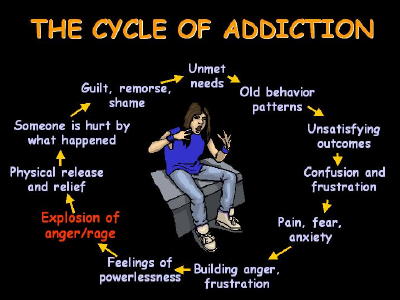
Learn all about anger and rage addiction in this article devoted entirely to dealing with the anger disorder of anger addiction and rage addiction. This kind of compulsive-addictive pattern can also result from unresolved grief.
The debilitating factor here is the way that the anger outbursts keep happening, and usually increase in intensity over time. No one has to live like that.
Passive aggressive behavior
This goes along with anger suppression, because many people just can't seem to hold it all inside. This is also sometimes called "sideways anger," which often comes out unconsciously. This can literally eat away at relationships, creating distance and hostility. Here are some examples of passive-aggressive behavior:
- Teasing or kidding around with someone when, if you're really honest with yourself, you know you're hurting their feelings. This is humor that is at someone else's expense, or you might say humor that has a victim.
- Asking a question that is really a statement, for example, "Are you sure you want to wear that?" is actually a criticism of the other person's choice of clothes.
- Sarcasm, cynicism and just being disagreeable can be forms of passive-aggressive behavior.
- Excluding the other person from something can also be a form of passive-aggressive behavior. You may have very good reasons to exclude them, but if the reason is just that you're angry at them and secretly want to "get back at them," then that's definitely passive-aggressive behavior.
One way to know if you have passive-aggressive behavior is to pay attention to your thoughts about the other person when they're not around. If you're thinking angry, resentful or bitter thoughts about them in their absence, chances are good that you will be passive-aggressive when you are with them.
"I love Dr. DeFoore's insight. This is life changing stuff I can use myself and recommend to others."
Samuel Taylor
Intermittent Explosive Disorder
This is an extreme anger disorder that is actually an official diagnosis in the DSM IV manual. Read our full article on Intermittent Explosive Disorder.
The reason this is considered to be a full blown psychological disorder is that at this level the condition takes on a life of its own, with many complex physical symptoms accompanying the psychological and emotional symptoms. It's like all of the other anger disorders rolled into one.
Learn more about Explosive Anger Disorder (EAD).
In this excellent audio program entitled, Anger: Deal With It Before It Deals With You, you will learn:
- Where the anger started and how knowing that will help you heal a disorder if you have one.
- The other emotions that go along with the anger.
- Specific tools and techniques to help you protect your relationships from your anger.
- Healthy ways to release and communicate all of your emotions.
You have a full money-back guarantee with this program, so there's absolutely nothing to lose.

ANGER: Deal
With It Before It Deals With You
A powerful and effective four-CD program addressing anger management, rage addiction and depression. Learn specific skills for dealing with your anger, overcoming rage, and creating positive, fulfilling relationships.
To listen to these previews, click the links below. When you're through listening, just close that window to return to this page.
Want Some Free Online Counseling?
Have A Question Or Story?
Here's your chance to ask Dr. DeFoore about your situation. It can be about your anger, somebody else's anger, or about grief, road rage, anxiety or depression. Tell your story with as much detail as possible, and he will give you some free counseling.
Feel free to also review our FAQ page (frequently asked questions), to see if your question has already been answered.
Then, if selected, the results will be a web page on this site that will help others! So, there you go--help and be helped! By the way, you can be anonymous if you choose, but if you include your first name, it's better.
What Other Visitors Have Said
Click below to see contributions from other visitors to this page...
Possible I.E.D. 
I have always suppressed anger- as in whenever something has made me angry, I have never been able to show it.
I don't know how to deal with anger. …
My Brother Is Abusing My Family
I have a brother 3 years younger than me. He is taller and bigger, and thinks he can control people with his words and actions. He tends to not listen …
Excessive Anger Outbursts
Hello. I completely lose control with my 2 year old daughter. Every day, I get stressed over mealtimes with her. I feel like she should eat some of what …
I Call Him Mr. Bipolar Not rated yet
My husband and I have been together for most of our childhood, and have been married for about two months.
His anger has been going on the 4 years …
Is This Intermittent Explosive Disorder (IED)? Not rated yet
I am 25 years old and after yet another crazy 'episode' occurred a few days ago, I decided enough was enough and have begun to research into what is wrong …
My Boyfriend's Intense Jealous Rages Not rated yet
I am not sure where to start, I guess I will start here. Me and my boyfriend have been together for 18 months. About 4 months into the relationship I …
Anger Leading To Clogging Of Thought Process Not rated yet
Hi, i am a man of 31 years of age, and this is my story. Right from childhood I was a happy child. With friends I was very popular, fun loving etc. I never …
Second Chances, Are They Worth It? Not rated yet
Eight years ago I left my abusive husband. He never hit me, but he got into drugs pretty bad. And it didn't help the problem he has had his entire life …
Bottled Up And Out! Not rated yet
How can I just get rid of the anger altogether? Going over the Anger Management Assessment scale above, mostly I'm at a "4" and when I'm upset I skip all …
I Actually Hit My Current Ex Boyfriend Not rated yet
Dear Dr. DeFoore
I have been in relationships in which my buttons weren't pushed to the point of hitting. I am still in shock and feel terrible about …
- Home
- Anger Management Assessment
- Anger Disorder
We receive commissions on Amazon sales on this website.


Subscribe To The Newsletter
And Get A Free Ebook!

Recent Articles


-
Always The Fool!
Aug 30, 25 05:20 PM
 I'm 51 years of age. Pro bodybuilder and personal trainer for 30 years. Unsure how to begin so will start off by saying... I've always been a carefree,
 -
Angry Outbursts Over Money
May 10, 25 09:04 AM
My husband is the best man I’ve ever known. I love him and only him. He’s a retired Army pilot but still flying. We have been married almost 19 years. -
My Brother, Their Son, And Our Family Business
Apr 02, 25 04:42 PM
 Hi there, my name is Caitlyn...and it feels like my life is falling apart. And I don't know what to do: My parents started a lucrative construction business
New! Comments
Have your say about what you just read! Leave me a comment in the box below.