GOODFINDING ebook Now On Sale for $.99!
The Seven Stages Of Grief
How To Grieve Without Getting Stuck
Authored by William G. DeFoore, Ph.D.

You may be able to manage the 7 stages of grief successfully on your own, as everyone grieves in their own way. You may find, however, that you need some guidance, coaching or counseling along the way to make sure you move through the stages and don't get stuck.

If you want practical skills for healthy grieving, skip ahead now. Remember, grieving is a natural part of life, loving and losing. It affects all of us at some point.
Do you have a grief and healing story to tell? We'd love to hear it, so share your story with us now! We all have a lot to learn from each other.
Grieving is all about love and loss. The 7 stages of grief begin with losing someone or something you love, and the greater the love the deeper the grief. When you go through the grief process, you are honoring the love and the depth of loss.
Death and loss are part of life, and so grieving is part of life. To grieve in ways that are good for you, you have to understand the 7 stages of grief and how to move through them.
Here's a chart that gives an overview of the grief process, in four phases:
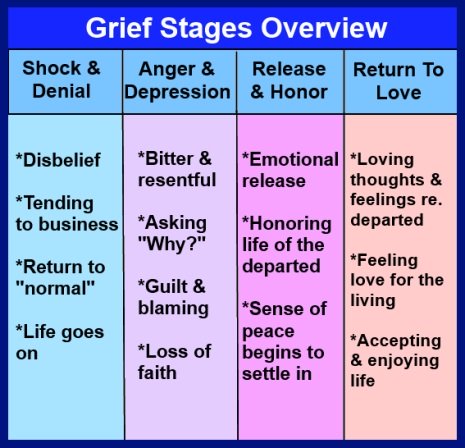
The 7 Stages Of Grief
Shock. This is your brilliant body/mind's method of protecting you from the overwhelming pain of your loss, at least right at first. It can be a blessing, but it can also turn into a numb feeling that prevents you from experiencing other positive emotions. Not to worry, though As long as you honor and move through all of the stages of grief, the shock will pass.
Denial. This is your magnificent mind's protection you from the sharper edges of your loss. You might pretend in the back of your mind that the person is still alive, or that you're still married to the spouse you've divorced. Denial is normal, but like the other stages of grief, you don't want to stay there too long.
Anger. This is a much stronger part of grief in the case of a death at an early age, or by violence or accident. Your anger could be at the injustice of what happened, or you could be mad at yourself, the person who died, or even with God for allowing it to happen. Learn these anger management techniques and you'll have no problem getting stuck at this stage of the grief process.
Guilt. It is natural to ask yourself, "What did I do wrong?" or "What could I have done to prevent this?" When you love someone, you automatically want to protect them. While this may be a normal part of the stages of grief for many, it certainly does not apply to everyone.

Pain And Sorrow. This is the heart and soul of the 7 stages of grief. These emotions of pain and sorrow are what you're avoiding when you're in shock, denial, guilt and anger. Fear can also show up here, because the depths of sorrow can be very frightening at times--it might feel like you will lose yourself if you let yourself feel all of that pain. Love is the key to moving through this stage. Remember the love you felt, longed for, and lost to help you move beyond the pain.
Release And Resolution. This part of the grief process is where you start to accept the reality of the loss, and begin letting go of the relationship at a deep level. You may also experience some forgiveness in this stage. At this point, you've moved past the denial, guilt and anger, and you're not hurting as bad as before. You might be wondering, "How long does this take?" That depends on what kind of loss you're experiencing, and how emotionally healthy you are. Your grief will come and go in cycles, stronger at times than others. Special occasions, anniversaries and birthdays can trigger a return of the pain and sorrow temporarily. Being "down" for any reason can also trigger your grief feelings. When you finally let go, your whole body will feel a sigh of relief. You can't rush this, or push through it. Follow the guidance on this page, however, and you will be able to move through your stages of grief.
Return To the Willingness To Love. This is the last stage of the grieving process. You have experienced some healing from your loss, and you're starting to successfully re-engage with your life. Fear can get in your way here, if you let yourself avoid loving again, to prevent the pain of future loss. By completing all of the 7 stages of grief, however, you will be able to move through that fear and love again. Learning to love yourself enough to create a joyful life is key here. The nurturing your inner child audio program will help you through the seven stages of grief, and prepare you for a new and optimistic transition into loving relationships. When you have self love, it is easier to remember the love you feel/felt for those you've lost, which is essential to healthy grieving.
This final step in the 7 stages of grief process is in many ways a spiritual one. Death is a part of life. You need to have a belief system that allows you to be at peace with this reality. You may find that through your chosen religion, or through some other teaching or school of thought.
Understanding The Grief Process
The more love you felt in the relationship, the greater the sense of loss you're dealing with. Grieving is directly connected with love, and healthy grief has elements of love and remembering love all the way through it.

The early stages of grief (denial, anger, guilt), where you can get so easily stuck, actually take you away from love.
The tricky part is that remembering (talking about, writing about) the love you felt, needed and lost) takes you straight into the heart of your pain. This is both the good news and the bad news--bad because it hurts, good because it heals. It is natural to avoid pain, but if you allow this to run the show, you will be stuck in your grief.
Ideas And Skills For Grieving
Grieving happens in waves and cycles. When the shock subsides, the first cycle of emotion may feel overwhelming. Every wave of grief subsides at some point, just as the waves on an ocean. Just remember as you move through the sorrow, that "this too shall pass away." If you use the tools on this page to grieve consciously and intentionally, the grief will pass more quickly.
The 7 stages of grief process lasts from months to years, depending on what kind of loss you've had. The cycles and waves will ebb and flow during the entire grief process, becoming farther and farther apart toward the end. If you resist or fight your grief, it will get stronger and last longer. Go with the flow of these emotions, and they will pass more quickly.
Some of your crying can be when you're by yourself. For most people, this is necessary because of awkwardness about showing deep emotion in front of others. It can also be very helpful, however, to cry with others who experienced the loss with you, or who are trusted loved ones that will stand by you in a calm way.
You need to know how to cry. Crying is a skill that can be taught and learned. Some have it naturally, but some have been punished or traumatized emotionally, making it difficult to cry openly and deeply.
You can imagine holding your inner child to help with the crying and letting go process. Get your copy of the audio program below, and you will find it will help you in your grieving.
Help With Crying & Emotional Release
- Go into a room where you will not be interrupted, and lower the lights. Curl up on a sofa or bed, wherever you're comfortable. Let your feelings in your body guide what you do.
- If you can, allow yourself to moan, wail, or make any type of vocal noise that fits with how you feel. These sounds need to come out, and they will help the feelings come out as well. You're actually releasing important emotion here, that will become toxic if you leave it inside.
- Hopefully, you will be able to sob, deep and long. Squeezing out a few tears is better than not crying at all, but it won't give you the release you want. You've had a big loss, and your body wants to express how it feels--grieving is a very physical process, as well as mental. You may need to have lots of good, deep, long sobbing sessions, depending on the type of loss you've experienced. Remember to breathe deeply during this, and relax your belly. That will help you let go of the emotion.
- Anger can come up at this point, and if it does, then you need to release that too.
- You will benefit greatly from creating your own grieving ritual or ceremony, or working with others who share the loss to create a ceremony. Beyond a funeral service, you may want to try some of these processes, as described below.
Create Your Own Personal Grieving Ceremony
- Find a private place where you won't be interrupted.
- Play some music that will remind you of the person you have lost. Or, just play any music that matches with the sorrow you're feeling.
- Create a mood, with candles or soft lighting.
- Take out photos, videos, and other memorabilia that remind you of your lost loved one or of the situation you are grieving. If you have cards or letters written in their hand, bring those out as well. Place this all around you, so that you can scan it easily with your eyes.
- Talk aloud or in your mind to the departed, or to anyone there with you that is associated with your loss. Write a letter expressing all of your feelings, just for you--even though you won't be sending it.
- Stay in that space until you have a feeling of release or resolution. You may want to do this many times during your stages of grief process.
- Ceremonies and rituals with friends and family can help you to move through the 7 stages of grief. Some examples are:
- Releasing balloons in a park or floating a candle down a stream or river.
- Sharing stories, in which you get together and swap memories and anecdotes about the departed. (Avoid anger, guilt and denial in these stories, since that could actually interfere with the grieving and letting go.) While these stages of grief are necessary, the purpose of such a gathering is love, release, forgiveness and healing.
- A memorial service with a combination of these practices will honor the departed and those left behind.
Since forgiveness can be such a big part of grieving and letting go, be sure and read through these forgiveness quotes.

You may be here because of one of many kinds of losses. Here is a list of losses which necessitate a period of grieving:
- Death of loved one
- Separation or Divorce
- Loss of identity and/or innocence through physical or sexual abuse
- Combat related PTSD
- Loss due to abandonment or rejection
- Loss of childhood through being required to take on too much responsibility too soon in life
- Loss of health through illness, injury or aging
- Unemployment and/or job loss
- Financial losses
- Moving/relocation of your home
You may be able to think of other types of losses that you or others have suffered, such as the ending of a relationship through divorce or separation. The important point to keep in mind is that you do not have to suffer from these losses for the rest of your life. You can take charge by moving through your own stages of grief to a point of peace and resolution, becoming wiser and stronger in the process.
Looking for even more information? Learn about the Kubler-Ross model of the grief stages.
Have A Story About Grief And Healing?
Do you have a story about your own grief and healing process? If, please share it. Even if it is a grieving issue that you are still dealing with, it might be helpful to others to read about your experience in the stages of grief. Who knows, they might even be able to help you.
Since grieving is an act of love, feel free to write about the love you felt for your loved one, pet or other losses you may have experienced. Help and be helped as you move through the 7 stages of grief.
Feel free to also review our FAQ page (frequently asked questions), to see if your question has already been answered.
What Other Visitors Have Said
Click below to see contributions from other visitors to this page...
Sober Grief 
I am sure everyone will agree with me that 2020 has been quite the year!
For me personally, it got worse before it got better.
In June of this …
Grief Over My Husband Breaks Me
Hi I am Anu, as my husband lovingly called me. I lost my husband a month and a half back and since then have been a total wreck. I just can’t control …
It's Just A Dog?
Hello, I’m from the Netherlands so if my English is not perfect I’m sorry. I’m in grief over a loved one, in my case I’m grieving over my dog who died …
Struggling To Know My Worth
All four of my older sisters and my one younger brother lost our mom April 17, 2010. It was unexpected and very emotional. I never really felt wanted …
I Died Young
My older brother left home when I was 8 and he was 13. Off to Military school.
As an older brother, (I am the youngest of 4 children), he was my …
13 Years After My Mom's Death And I'm Still Angry
On April 2, 2002, my mom passed away. She was my mom, my sister and my best friend.
My parents split up soon after I was conceived, and I never met …
Father, Grandfather, Best Friend, Comforter, and Rock of Wisdom Lost, But Still Present: Grief and Gratitude
I lost my grandfather 3 months ago but I feel like I lost one of the greatest men in the world. I feel like I lost the greatest person in MY world.
…
They Are All Gone
Recently, I lost my last brother to suicide. I understand why he did it, he was in intense pain, mostly physical. He also suffered from bipolar disorder …
I Can't Be With My Love And I Can't Get Over Him Not rated yet
I am 30 years old Arab divorcee with a child from Libya. Am beautiful trustworthy strong woman, or that is what people are saying about me. When I was …
I'm Having Anger After Multiple Losses From Miscarriages Not rated yet
Yes my name is Norris. I'm 25 years old and my life just seems so unfair. About 4 years ago I met my fiancé. She is the love of my life.
She has …
Letting Go Of Anger Over My Mother's Death Not rated yet
Hello. I was seventeen when my mother died of cancer and I am now 38. I still feel anger deep inside confused with fear and a sense of abandonment. I miss …
- Home
- Anger Management Worksheets
- Stages of Grief
We receive commissions on Amazon sales on this website.


Subscribe To The Newsletter
And Get A Free Ebook!

Recent Articles


-
Am I Somehow Deserving Of The Abuse?
Oct 16, 23 08:44 AM
 Dear Dr. DeFoore, I have been married for over 6 years and my relationship has become unrecognizable and full of resentment and hatred. Over the last
 -
The War In My Mind Or My Reality?
Jul 13, 23 09:08 AM
 I share my short story of endurance with triggers of my past military wounds to help heal myself and others. To inspire you to believe in yourself and
 -
Completely Confused By 20 Year Old Son's Behavior
Jul 06, 22 08:59 AM
 My son is 20 years old. He is extremely intelligent. He excelled in school and was at the top of his high school senior class. He was accepted into every
New! Comments
Have your say about what you just read! Leave me a comment in the box below.